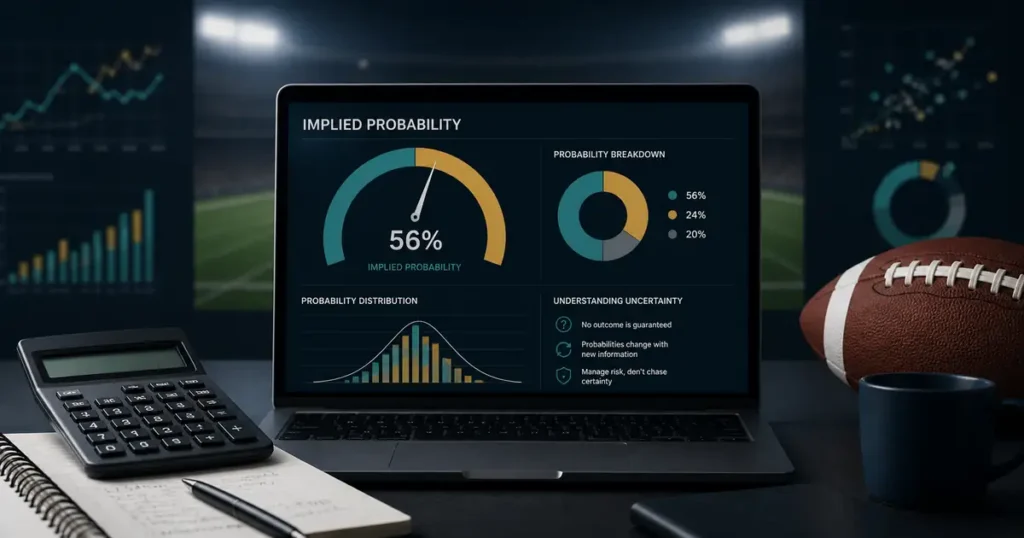
Implied probability in betting turns decimal odds into an estimated percentage chance. It can help you understand how a sportsbook has priced an outcome, compare markets more clearly, and make more deliberate decisions. However, the percentage is not a prediction, a promise, or a reason to increase your stake.
This guide explains the formula in plain language, provides practical examples, and highlights the limits that every bettor should understand. Betting should remain an optional form of entertainment for adults of legal gambling age.
What Is Implied Probability in Betting?
Implied probability is the chance suggested by betting odds. Shorter decimal odds produce a higher implied percentage, while longer odds produce a lower percentage. For example, odds of 2.00 imply a 50% chance before considering the sportsbook margin.
The calculation helps translate a price into a format that is easier to compare. It does not reveal the true chance of an event with certainty. Sports results remain unpredictable, and even carefully researched selections can lose.
The Formula for Decimal Odds
Use this simple formula:
Implied probability = (1 ÷ decimal odds) × 100
Enter the decimal price, divide one by that number, and multiply the result by 100. The answer is a percentage.
Example 1: Decimal Odds of 2.00
(1 ÷ 2.00) × 100 = 50%
A price of 2.00 represents an implied probability of 50%. This does not mean the outcome will happen half the time in a small sample. It simply describes the probability represented by the price.
Example 2: Decimal Odds of 1.80
(1 ÷ 1.80) × 100 = 55.56%
A price of 1.80 represents an implied probability of approximately 55.56%. Rounding to two decimal places is normally enough for simple comparisons.
Example 3: Decimal Odds of 3.50
(1 ÷ 3.50) × 100 = 28.57%
A price of 3.50 represents an implied probability of approximately 28.57%. A larger potential return comes with a lower probability suggested by the odds.
Why Market Percentages Can Add Up to More Than 100%
If you convert every outcome in a market, the percentages often total more than 100%. The extra amount is commonly called the sportsbook margin or overround. It is one way the operator builds a commercial advantage into its prices.
Imagine a two-outcome market where both choices are offered at 1.91. Each price implies about 52.36%, so the combined total is approximately 104.72%. The amount above 100% reflects the margin. Comparing prices across licensed sportsbooks can show which market offers a smaller margin, but it never removes risk.
How Implied Probability in Betting Helps Compare Odds
Implied probability is most useful as a comparison tool. Write down the event, market, decimal odds, calculated percentage, and your reason for considering the selection. Then pause before committing money.
- Check that you understand the market rules and settlement conditions.
- Compare the same market rather than two different bet types.
- Use a fixed entertainment budget that does not include essential expenses.
- Keep stakes small and consistent instead of reacting to recent results.
- Never chase a loss or borrow money to continue betting.
Calculations can make a decision more organized, but they cannot make betting safe or profitable. Your financial and time limits should always come first.
Implied Probability and Asian Handicap Markets
Asian handicap prices are often displayed as decimal odds. You can convert those prices with the same formula, but first make sure you understand the handicap line, including whole, half, and quarter handicaps. Pushes and split stakes can change how a result is settled.
Read our Asian handicap betting guide before comparing prices in these markets. Understanding settlement rules is more important than calculating a percentage quickly.
Implied Probability and Draw No Bet
Draw No Bet removes the draw as a losing outcome because the stake is normally returned when the match finishes level. The decimal price still produces an implied percentage, although the refund condition affects how the market should be evaluated.
For a clearer explanation, see the pros and cons of Draw No Bet. Compare only equivalent markets and confirm the operator’s rules before placing any selection.
Limits of Implied Probability in Betting
Implied probability has several limitations. Odds can move when new information becomes available or when the market changes. The calculation also reflects the listed price, which includes a margin, rather than an objective forecast.
- It does not account for every injury, lineup change, weather condition, or tactical decision.
- It does not guarantee that a higher-probability outcome will win.
- It cannot remove short-term variance or unexpected events.
- It does not tell you how much to stake.
- It is not proof that a bet offers value or future profit.
Treat the percentage as one piece of information, not a final answer.
Common Beginner Mistakes
Confusing Probability With Certainty
An implied probability of 70% still includes a meaningful chance of losing. Avoid language such as “sure win” or “guaranteed result.” No legitimate calculation can guarantee a sporting outcome.
Ignoring the Sportsbook Margin
Looking at one percentage in isolation can hide the cost built into the whole market. Convert all available outcomes if you want to estimate the overround.
Increasing Stakes After a Loss
A recent loss does not make the next selection more likely to win. Changing your stake to recover money is loss chasing and can quickly exceed your budget.
Using Money Needed for Daily Life
Only use money set aside for entertainment. Rent, food, utilities, savings, debt payments, and family needs should never depend on a betting result.
A Responsible Checklist Before You Bet
- Confirm that betting is legal for your age and location.
- Set a spending limit and a time limit before opening the platform.
- Decide on a small stake without using potential winnings in your plan.
- Record the odds and reason for the selection.
- Take regular breaks and stop when the session limit is reached.
- Use deposit limits, cooling-off tools, or self-exclusion if needed.
If betting causes stress, secrecy, conflict, financial pressure, or repeated attempts to recover losses, stop and seek support. The National Council on Problem Gambling provides safer sports betting guidance and information about support options. Look for an appropriate service in your own country or region.
Frequently Asked Questions
What does 60% implied probability mean?
It means the listed odds represent an estimated 60% chance before any deeper assessment. It does not mean the outcome is certain or that it will occur six times in every short set of ten events.
Can implied probability identify a winning bet?
No. It translates odds into a percentage. Identifying a difference between your estimate and the listed price still involves uncertainty, incomplete information, and financial risk.
Does the formula work with decimal odds only?
The formula shown here is for decimal odds. Fractional and American odds can also be converted, but they use different calculations or should first be converted to decimal format.
Final Thoughts
Implied probability in betting is a useful way to read decimal odds and compare prices. Use the formula carefully, consider the sportsbook margin, and remember that a percentage is not a prediction. Set firm money and time limits, keep stakes affordable, and step away whenever betting stops feeling like entertainment.