
In 2001, the PGA TOUR launched a technology that forever revolutionised golf. The PGA TOUR ShotLink System captured and reported everything – from shot to player information – in real time. Since its release, it has helped players and coaches refine their strategies, architects redesign courses, and tournament officials set up the course.
Beyond the people involved in preparing and playing the game, bettors can also benefit from using analytics in golf betting. While golf may be known as a “rich person’s sport,” its popularity has gone beyond the higher classes through sports betting. This trend has stretched past its Western origins, with golf betting markets available everywhere, such as at sites for online betting in Singapore.
Types of Analytics in Golf Betting
Technology is evolving, and soon, the data analytics involved in golf will too. Bettors need to understand the basics now to improve their wins.
1. Strokes Gained
Strokes Gained offers a detailed evaluation of a player’s performance relative to the field. It breaks down the game into specific categories to assess how a golfer gains or loses strokes compared to their competitors. These categories include off-the-tee, approach, around-the-green, and putting.
- SG: Off-the-Tee metric evaluates how effective a player is with their drives, combining distance and accuracy. For players tackling long courses, this metric is particularly valuable as it highlights those who can hit far while avoiding trouble.
- SG: Approach focuses on a player’s ability to hit the green with precision using their irons or wedges. This is a critical skill on courses with small or strategically protected greens.
- SG: Around-the-Green assesses short-game performance, such as chipping or pitching, which is vital on layouts with thick rough or bunkers.
- SG: Putting measures success on the greens, accounting for variables like distance, slope, and green speed. It is essential for courses with challenging putting surfaces.
The technology behind these metrics is powered by ShotLink, which uses lasers and cameras to track every shot during PGA Tour events. It captures data on ball trajectory, distance, and proximity to the hole, allowing for precise calculation of strokes gained.
2. Driving Distance
In modern golf, driving distance has become increasingly important as courses have lengthened and players have developed more powerful swings. It measures the average distance a player hits the ball off the tee, reflecting their power and ability to cover ground effectively.
Longer drives often mean shorter approach shots, which can improve accuracy when hitting greens. However, it is essential to balance distance with accuracy; simply hitting the ball far does not guarantee success if it frequently lands in hazards or rough.
Driving Distance is calculated using a golf GPS, watch, or club sensors, as these devices can measure the distance a player hits each club. Rangefinders or simulators are also used to calculate the club distance.
For a more traditional approach, bettors can calculate the Driving Distance by using a specific formula that incorporates several key variables: ball speed, club speed, and launch angle. It is expressed as follows:
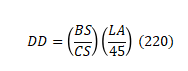
- DD represents the drive distance in yards
- BS is the ball speed in miles per hour
- CS is the club speed in miles per hour
- LA is the launch angle in degrees
To begin, measure the club speed, ball speed, and launch angle accurately. Once you have these values, substitute them into the formula to estimate your drive distance. Keep in mind that this calculation provides a rough estimate; actual distances may vary due to additional factors such as spin rate and environmental conditions.
3. Fairway Accuracy
The fairway is the golf course area between the tee and the green where the grass is cut shorter than the rough. Because of its short, even grass, it is the easiest part of the course to hit the ball from.
Fairway Accuracy indicates the percentage of drives that land on the fairway. This metric helps assess a player’s consistency and control off the tee, which are critical for setting up subsequent shots.
A higher fairway accuracy percentage suggests better control over tee shots, which is crucial for maintaining scoring opportunities throughout a round. Players who consistently find the fairway can approach greens with more confidence and less risk of encountering hazards or difficult lies in rough terrain. It is calculated by dividing the number of fairway hits by total drives and then multiplying by 100 to obtain a percentage.
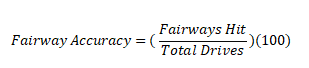
However, since Fairway accuracy is a binary statistic, it only checks if the fairway was hit or not. It does not account for the distance of the shot or how badly the fairway was missed.
4. Greens in Regulation (GIR)
Another relevant golf data is “greens in regulation” (GIR), which measures how often a player reaches the green in two strokes less than par. A higher GIR percentage typically correlates with lower scores because it indicates that players are giving themselves more birdie opportunities. Players who excel at hitting greens are often more successful because they can avoid scrambling situations where they must recover from missed greens.
Green in Regulation is calculated by subtracting the number of putts a player has recorded from their total score for a hole.
On a Par 5, a GIR is achieved by hitting the green in three strokes. On a Par 4, however, it is achieved by hitting the green in two strokes. While on a Par 3, it is achieved by hitting the green with the first stroke.
5. Putts Per Round
Putting is often considered one of the most critical aspects of golf; even small improvements can lead to significant reductions in scores. Putts per Round racks the average number of putts taken per round, providing insight into putting efficiency and overall scoring ability.
Fewer putts per round generally indicate better putting performance and can significantly impact overall scores. Players who consistently putt well are often able to capitalise on their strong approach shots by converting birdie opportunities or saving pars when they miss greens. To calculate it, bettors simply need to take the total number of putts made during rounds played and divide this figure by the total rounds played.
6. Scrambling
Scrambling measures a player’s ability to save par after missing the green. This metric is crucial for evaluating short-game proficiency because it reflects how well players recover from less-than-ideal situations on the course.
A high scrambling percentage indicates that a player can recover well from missed greens, which is essential for maintaining lower scores throughout a round. Players who excel at scrambling often have strong chipping and pitching skills as well as effective putting abilities around the green. To calculate for this model, bettors can divide the total number of successful scrambles by the Greens in Regulation and then multiplying by 100 to get a percentage.

Improve Golf Bets with Analytics
A data-driven golf bet makes all the difference. Here are some betting tips that leverage performance metrics, allowing bettors to gain valuable insights into player capabilities and make more informed decisions:
1. Identify Relevant Metrics
While bettors do not need to memorise every statistic, understanding the most relevant metrics will help them assess players’ strengths and weaknesses. It is best to focus on the metrics that align with the specific tournament conditions and course characteristics.
2. Analyse Course Conditions
Different courses present unique challenges that can significantly impact player performance. Research the course layout, including its length, terrain, and typical weather conditions. Understanding whether the course is a links-style or parkland layout can help you determine which players might excel.
Additionally, consider how weather conditions like wind and rain can affect scoring; players who perform well under similar conditions in previous tournaments may have an advantage.
3. Evaluate Players’ Recent Performance
Golf tournament players are often at the top of their league, but they can have setbacks too. It is best to assess their statistics over the last several tournaments to gauge current player form. Consider factors such as consistency and trends in their performance.
A player who has recently improved their putting game may be poised for a breakout performance, making them a valuable betting option.
4. Compare Head-to-Head Matchups
Sometimes, the best strategy for making accurate golf predictions is to compare relevant golf betting analytics together. This will help identify potential advantages that could influence the outcome of the matchup.
5. Monitor Betting Lines and Market Movement
Golf betting odds can shift based on public perception and betting volume. If there are noticeable changes in odds for a player whose metrics suggest strong potential, it may indicate an opportunity for value betting. Being aware of these fluctuations allows bettors to make timely bets that capitalise on favourable odds.
6. Adjust Your Strategy Based on Results
After each tournament concludes, take time to review betting results and analyse what was effective. Reflect on the effectiveness of the metrics used—did certain statistics correlate with successful bets?
Consider whether course conditions influenced unexpected outcomes or if any players performed contrary to their metrics. These insights can be utilised to improve strategies for future tournaments, such as the Ryder Cup on September 26-28, 2025, and the Open Championship on July 13-20, 2025.
Make Data-Driven Golf Bets at 88ProAsia
With all the tour events in 2025, these golf performance metrics will play an increasingly vital role in helping players achieve their best performances and bettors make the most of their picks.
Enjoy the thrill of the game through Singapore sport bet sites. As the sports scene continues to grow,88ProAsia remains one of the country’s reputable sites for online betting.
Register here to experience competitive odds, secured payouts, and promising bonuses.