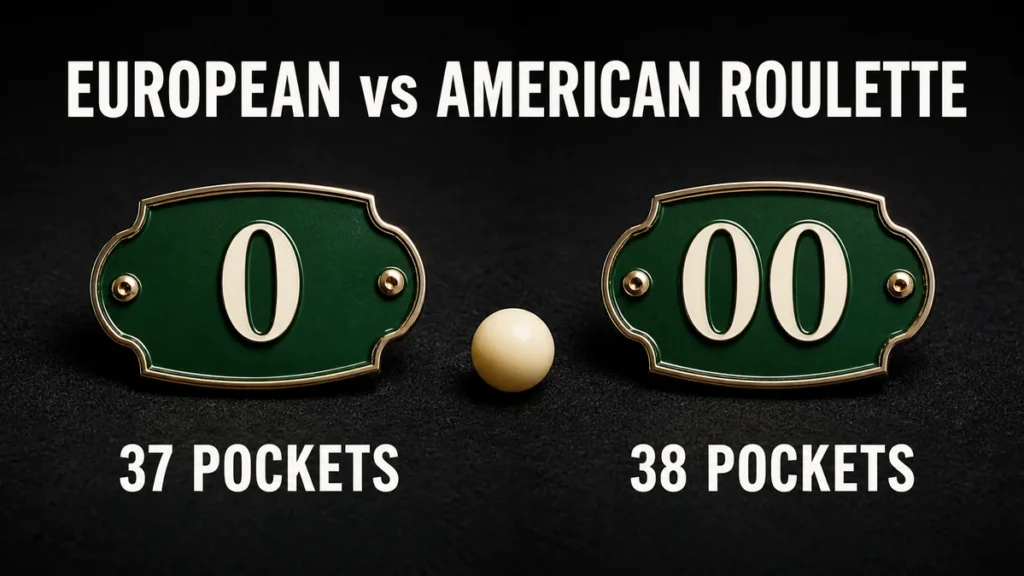
European vs American roulette comes down to one extra pocket: the standard European wheel has a single zero, while the standard American wheel has both zero and double zero. With conventional payouts, that extra outcome increases the mathematical advantage held by the casino.
This guide explains the differences in wheel layout, probability and house edge. It is educational information for adults, not a recommendation to gamble or a promise of profit. For broader context, read our online casino guide for Singapore and Malaysia.
European vs American roulette: quick comparison
| Feature | European | American |
|---|---|---|
| Total pockets | 37 | 38 |
| Green pockets | 0 | 0 and 00 |
| Single-number probability | 1/37 ≈ 2.70% | 1/38 ≈ 2.63% |
| Straight-up payout | 35:1 profit | 35:1 profit |
| Standard house edge* | 2.70% | 5.26% |
| Theoretical RTP* | 97.30% | 94.74% |
*Assumes equally likely pockets, conventional payouts and no special zero rules. The American five-number bet is an exception, explained below. Percentages are rounded.
Wheel layout: fixed sequences, not numerical order
Both wheels contain numbers 1–36. Their physical number sequences differ, but neither is simply 1, 2, 3 and so on around the rim. The sequences are fixed; they do not become a fresh random arrangement on each spin. The numbered grid on the betting table is a different layout from the wheel itself. The New Jersey gaming-equipment regulations, section 13:69E-1.7, document both configurations.
Why the extra zero changes the house edge
A standard straight-up win pays 35 units of profit plus the original one-unit stake. That is a total return of 36 units. Using a hypothetical one-unit stake, the expected net result is:
European: (1/37 × 35) − (36/37 × 1) = −1/37, or approximately −2.70%.
American: (1/38 × 35) − (37/38 × 1) = −2/38, or approximately −5.26%.
These are averages across a mathematical model of many repeated wagers, not forecasts for one person. A lower house edge does not make a game profitable for the player. It also does not prevent a large short-term loss.
The American five-number exception
The five-number bet covers 0, 00, 1, 2 and 3 and conventionally pays 6:1 profit. Its expected net result is (5/38 × 6) − (33/38 × 1) = −3/38. That produces a 7.89% house edge and approximately 92.11% theoretical RTP, not a 6.89% house edge. Definitions and payouts appear in the Massachusetts Gaming Commission roulette rules, sections 1 and 2.
RTP and table rules need careful reading
Return to player, or RTP, describes a theoretical long-run proportion of total stakes returned as payouts, including returned winning stakes. It is not a refund rate, a savings return or a guarantee that you will recover that proportion of a deposit. Reusing returned money also increases the total amount wagered.
Always check the actual game rules. Optional zero treatments, special bets and modified payouts can change the calculations. A game name alone is not enough to establish its house edge. This comparison does not cover every branded roulette variant.
Frequently asked questions
Does double zero count as red or black?
No. On a standard double-zero wheel, 0 and 00 are green. They are separate outcomes from the red and black numbers.
Can previous spins predict the next result?
In the independent-spin model used here, previous results do not change the next spin’s probabilities. A run of one colour does not make the other colour due. Increasing a stake after losses does not remove the underlying house edge.
Does a lower house edge guarantee a better session?
No. House edge describes expected loss relative to the amount wagered, not the outcome of any particular session. Neither version guarantees winnings.
Keep the comparison in perspective
Understanding the numbers helps explain risk; it does not eliminate it. Follow local laws and age restrictions. Never use money needed for essentials, borrow to gamble or chase losses. If gambling feels difficult to control, stop and seek support.
Fact-checked and updated: 30 August 2026. Calculations above are derived from the stated pocket counts and payouts. The regulatory sources document game mechanics, not the legal status of any website in Singapore or Malaysia.